
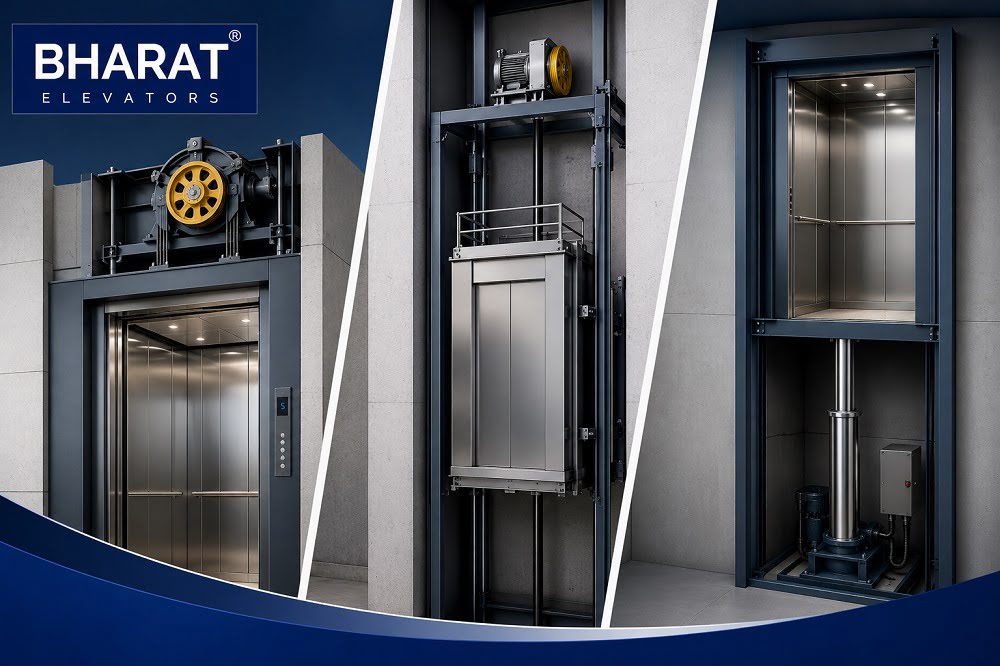
Choosing the right elevator system is important for ensuring safety, efficiency, comfort, and long-term performance in residential, commercial, and industrial buildings. Bharat Elevators provides advanced lift solutions in Hyderabad including Traction Lifts, MRL Lifts, and Hydraulic Lifts designed to meet diverse building requirements.
Each lift type offers unique advantages depending on the building structure, travel height, load capacity, maintenance requirements, and energy efficiency goals. Understanding the differences between these elevator systems helps property owners, builders, architects, and businesses make informed decisions.
Understanding Different Types of Elevator Systems
Importance of Selecting the Right Lift
The choice of lift system directly impacts building efficiency, passenger comfort, operational costs, and maintenance requirements. Bharat Elevators helps customers identify the most suitable elevator technology based on building size, usage patterns, budget, and installation conditions.
Common Lift Technologies Used Today
Modern buildings commonly use three major types of lift systems:
- Traction Lifts
- Machine Room Less (MRL) Lifts
- Hydraulic Lifts
Each system operates using different mechanisms and is suitable for specific applications.
What are Traction Lifts
How Traction Lifts Work
Traction lifts operate using steel ropes or belts connected to a motor and counterweight system. The motor moves the elevator cabin up and down through traction between the ropes and pulley system.
These lifts are commonly installed in medium-rise and high-rise buildings because they provide smooth travel, higher speed, and energy-efficient performance.
Key Features of Traction Lifts
- High-speed elevator operation
- Suitable for tall buildings
- Smooth and comfortable ride quality
- Energy-efficient operation
- Counterweight balancing system
- Ideal for frequent usage
Advantages of Traction Lifts
Traction elevators offer excellent performance for residential apartments, commercial complexes, hospitals, hotels, and office buildings.
Benefits include:
- Faster travel speed
- Lower energy consumption
- Better ride comfort
- Suitable for multiple floors
- Long operational lifespan
- Reduced operating costs over time
Applications of Traction Lifts
Traction lifts are commonly used in:
- High-rise residential buildings
- Commercial office spaces
- Shopping malls
- Hotels
- Hospitals
- Corporate buildings
What are MRL Lifts
How MRL Lifts Work
MRL stands for Machine Room Less elevators. These lifts operate similarly to traction elevators but eliminate the need for a separate machine room. The motor and control equipment are installed within the lift shaft.
MRL lifts are becoming increasingly popular in modern buildings because they save space and reduce construction requirements.
Key Features of MRL Lifts
- No separate machine room required
- Space-saving design
- Energy-efficient motor systems
- Compact installation
- Modern elevator technology
- Quiet and smooth operation
Advantages of MRL Lifts
MRL elevators provide an excellent balance between performance, energy efficiency, and space optimization.
Benefits include:
- Reduced building construction cost
- Better space utilization
- Lower energy consumption
- Modern and compact design
- Easy installation in limited spaces
- Reduced maintenance requirements
Applications of MRL Lifts
MRL lifts are ideal for:
- Residential apartments
- Commercial buildings
- Mid-rise structures
- Hospitals
- Educational institutions
- Retail complexes
What are Hydraulic Lifts
How Hydraulic Lifts Work
Hydraulic lifts operate using hydraulic fluid pressure to move the elevator cabin. A hydraulic pump pushes fluid into a cylinder, which raises the lift platform.
These lifts are commonly used in low-rise buildings and heavy-duty lifting applications.
Key Features of Hydraulic Lifts
- Hydraulic piston lifting mechanism
- Smooth lifting operation
- High load carrying capacity
- Suitable for low-rise buildings
- Cost-effective installation
- Reliable heavy-duty performance
Advantages of Hydraulic Lifts
Hydraulic elevators are known for their strength, simplicity, and affordability.
Benefits include:
- Ideal for heavy loads
- Lower initial installation cost
- Smooth start and stop movement
- Simple operating mechanism
- Suitable for limited floor travel
- Effective for industrial applications
Applications of Hydraulic Lifts
Hydraulic lifts are commonly installed in:
- Villas and homes
- Warehouses
- Industrial facilities
- Small commercial buildings
- Automobile workshops
- Goods lifting applications
Difference Between Traction Lifts, MRL Lifts, and Hydraulic Lifts
Operating Mechanism
Traction lifts use ropes and counterweights, MRL lifts use compact traction systems without machine rooms, while hydraulic lifts use hydraulic fluid pressure for movement.
Space Requirements
MRL lifts require less building space because there is no separate machine room. Traction lifts generally require machine rooms, while hydraulic lifts need space for hydraulic equipment.
Speed and Performance
Traction lifts provide the highest travel speed and are suitable for tall buildings. MRL lifts offer moderate to high-speed performance, while hydraulic lifts operate at slower speeds.
Energy Efficiency
MRL and traction lifts are generally more energy-efficient compared to hydraulic lifts, especially in high-traffic buildings.
Building Height Compatibility
Traction lifts are ideal for high-rise buildings, MRL lifts are suitable for low-rise and mid-rise structures, and hydraulic lifts are best for low-rise applications.
Installation Cost
Hydraulic lifts often have lower initial installation costs, while traction and MRL lifts may involve higher setup expenses depending on building requirements.
Maintenance Requirements
Traction and MRL lifts usually require advanced technical maintenance, while hydraulic lifts have comparatively simpler maintenance systems.
Which Lift is Best for Your Building
Best Lift for High-Rise Buildings
Traction lifts are the preferred option for high-rise residential and commercial buildings because of their speed, efficiency, and smooth operation.
Best Lift for Space Optimization
MRL lifts are ideal when building space is limited and developers want to avoid constructing a separate machine room.
Best Lift for Heavy Loads and Low-Rise Buildings
Hydraulic lifts are suitable for industrial applications, goods transportation, villas, and low-rise commercial buildings.
Why Choose Bharat Elevators
Customized Lift Solutions
Bharat Elevators provides customized lift systems based on building structure, passenger requirements, load capacity, and architectural design.
Advanced Technology and Safety
Our lift systems are designed with modern technology and advanced safety features to ensure reliable and safe vertical transportation.
Professional Installation Services
Our experienced engineers and technicians handle lift installation with precision and compliance with industry safety standards.
Maintenance and Support
Bharat Elevators offers regular maintenance, repair services, modernization, and technical support for all elevator systems.
Affordable and Reliable Elevator Solutions
We provide cost-effective lift solutions without compromising on quality, durability, or performance.
Contact Bharat Elevators for Expert Lift Solutions
Bharat Elevators offers advanced Traction Lifts, MRL Lifts, and Hydraulic Lifts in Hyderabad for residential, commercial, and industrial applications. Our experts help customers select the ideal elevator system based on building type, operational needs, and budget.
Contact Bharat Elevators today for professional consultation, lift installation, and maintenance services.
Frequently Asked Questions
What is the main difference between traction lifts and hydraulic lifts?
Traction lifts use ropes and counterweights for movement, while hydraulic lifts use hydraulic fluid pressure to raise and lower the cabin.
What does MRL stand for in elevators?
MRL stands for Machine Room Less elevators, which do not require a separate machine room for lift equipment.
Which lift is best for high-rise buildings?
Traction lifts are the best option for high-rise buildings because they provide higher speed and energy-efficient operation.
Are MRL lifts energy efficient?
Yes, MRL lifts are highly energy efficient and consume less power compared to traditional elevator systems.
Which lift is suitable for villas and low-rise buildings?
Hydraulic lifts are commonly preferred for villas, homes, and low-rise buildings because of their smooth operation and lower installation cost.
Do traction lifts require a machine room?
Traditional traction lifts usually require a machine room for motor and control systems.
Which lift type requires less space?
MRL lifts require less building space because they eliminate the need for a separate machine room.
Does Bharat Elevators provide all types of lift systems?
Yes, Bharat Elevators provides Traction Lifts, MRL Lifts, Hydraulic Lifts, goods lifts, passenger lifts, and customized elevator solutions in Hyderabad.
Which lift is better for heavy-duty industrial use?
Hydraulic lifts are often preferred for heavy-duty industrial applications and goods transportation because of their high load capacity.
Does Bharat Elevators offer lift maintenance services?
Yes, Bharat Elevators provides complete lift maintenance, repair services, inspections, modernization, and technical support for all elevator systems.