

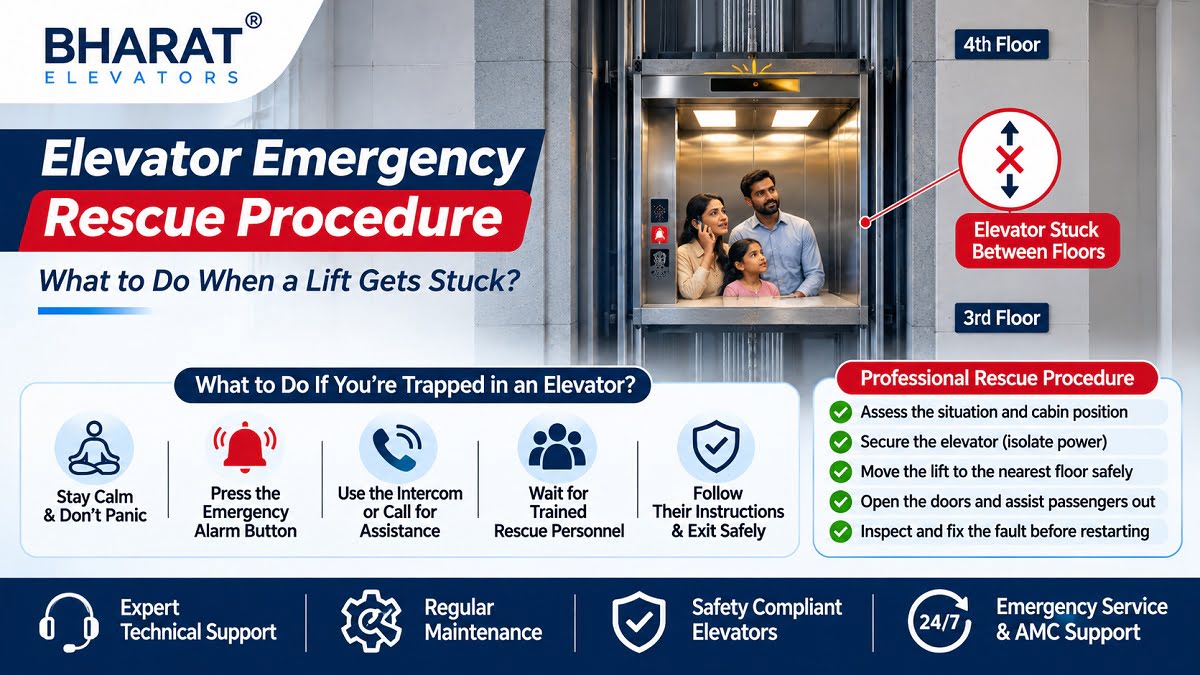
An elevator is an essential part of modern residential, commercial and industrial buildings. It provides convenient movement between floors and makes everyday transportation easier. However, like any mechanical and electrical system, an elevator can occasionally experience an unexpected breakdown or operational failure.
One of the most concerning situations for passengers is getting trapped inside an elevator between floors. A sudden power failure, control system malfunction, door problem or mechanical fault can cause a lift to stop unexpectedly.
Knowing the correct elevator emergency rescue procedure is important for passengers, building owners, security personnel, facility managers and elevator maintenance technicians. The right response can help keep trapped passengers calm, prevent unsafe actions and ensure that a rescue is performed by trained personnel.
At Bharat Elevators, we believe elevator safety goes beyond equipment installation. Proper maintenance, emergency preparedness, reliable safety systems and professional technical support are essential for dependable elevator operation.
In this guide, we explain what to do when an elevator gets stuck, how an emergency rescue operation is conducted, which safety precautions must be followed and how building owners can prevent elevator emergencies.
Elevator Emergency Rescue Procedure – Understanding Lift Entrapment and Passenger Safety
An elevator entrapment occurs when the elevator cabin stops unexpectedly and passengers cannot exit through the normal landing doors.
This may happen because of an electrical interruption, mechanical issue, safety circuit activation or control system fault.
Although getting trapped inside a lift can be frightening, a properly maintained elevator generally has safety features designed to protect passengers during unexpected stops.
The most important thing is to remain calm, avoid attempting to force the doors open and contact the building’s emergency response team or elevator maintenance provider.
1. What Causes an Elevator to Get Stuck?
Understanding the common causes of elevator entrapment helps building owners and maintenance teams take appropriate preventive measures.
Power Failure
A sudden electricity interruption can stop an elevator during operation. Depending on the elevator configuration, an Automatic Rescue Device (ARD) or other approved emergency system may move the cabin to a suitable landing and allow the doors to open.
If the system does not operate or another fault is present, passengers may remain inside until a trained rescue team arrives.
Elevator Control Panel Malfunction
The elevator control panel manages various operating functions, including floor selection, motor operation, door movement and safety monitoring.
A controller fault, electrical component failure or communication problem may cause the elevator to stop.
Door Interlock Problems
Elevator door interlocks are safety devices that help ensure the elevator operates only when the required door safety conditions are satisfied.
If an interlock or associated safety circuit develops a fault, the elevator may stop or refuse to move.
Motor or Drive System Failure
The elevator motor and drive system are responsible for moving the cabin. A fault in the motor, variable frequency drive, braking arrangement or related equipment can interrupt normal operation.
Safety Circuit Activation
Elevators are equipped with safety circuits that monitor important operating conditions. When an unsafe condition is detected, the system may stop the elevator to prevent further movement.
Mechanical Component Problems
Issues involving suspension components, braking equipment, guide systems or other mechanical parts can also lead to an elevator shutdown.
The actual cause must be identified by a qualified elevator technician before the lift is returned to service.
2. What Should You Do When an Elevator Gets Stuck?
If you are inside an elevator that suddenly stops, follow these safety instructions.
Step 1: Stay Calm and Do Not Panic
The first and most important step is to remain calm.
An unexpected elevator stoppage can cause anxiety, but panic may lead to unsafe decisions.
Remember:
- Stay inside the elevator cabin.
- Move away from the doors.
- Avoid unnecessary movement.
- Do not attempt to force the doors open.
- Reassure other passengers.
Most modern elevators have safety provisions designed to protect occupants during an unexpected stoppage. However, the cabin should not be treated as safe for indefinite waiting; contact emergency assistance immediately.
Step 2: Press the Emergency Alarm Button
Locate the emergency alarm button on the elevator control panel.
Press it to alert building security, maintenance personnel or another designated emergency contact.
Some elevators have an emergency communication system that connects passengers directly to a monitoring centre or assistance team.
Use the communication system to explain:
- That the elevator has stopped.
- The approximate number of passengers inside.
- The building location, if known.
- Whether anyone needs medical assistance.
Step 3: Use the Emergency Communication System or Mobile Phone
If the emergency alarm does not produce a response, use the elevator’s emergency phone or your mobile phone to contact building security, the facility manager or the elevator maintenance provider.
Provide the building name, elevator location and available floor information.
If there is a serious medical emergency, breathing difficulty, fire or another immediate threat, contact the appropriate local emergency services as well.
Step 4: Wait for Trained Rescue Personnel
Once the emergency has been reported, wait for authorized rescue personnel.
Do not attempt to exit through the elevator roof, emergency hatch or gap between the cabin and landing.
The elevator may be positioned between floors, and its movement or electrical systems may present serious hazards.
Step 5: Follow Rescue Team Instructions
When trained personnel reach the elevator, follow their instructions.
Remain away from the doors until they confirm that it is safe to exit.
If the cabin is not level with the landing, do not try to climb or jump out. Wait for the rescue team to carry out the appropriate procedure.
3. What Should You Never Do During an Elevator Emergency?
Incorrect rescue attempts can turn a manageable elevator breakdown into a serious accident.
Passengers and untrained building staff should avoid the following actions.
Never Force the Elevator Doors Open
Do not pull, push or try to separate the elevator doors.
The cabin may not be level with the floor, and opening the doors could expose passengers to the elevator shaft.
Never Climb Out Through the Emergency Hatch
The emergency hatch is intended for authorized rescue or maintenance procedures, not routine passenger escape.
Do not climb onto the cabin roof or attempt to reach the nearest landing independently.
Never Jump Inside a Stopped Elevator
Jumping, shaking or repeatedly moving around the cabin will not restart the elevator.
It can also create unnecessary risk, particularly if several passengers are inside.
Never Attempt Electrical Repairs
Do not open control panels, touch electrical wiring or operate unfamiliar switches.
Elevator electrical systems must be handled by qualified personnel.
Never Allow Untrained People to Perform a Rescue
A person without appropriate training may not know the elevator’s position, braking arrangements, electrical isolation requirements or door-locking mechanisms.
Emergency rescue must follow the equipment-specific procedure and applicable safety requirements.
4. How Is an Elevator Emergency Rescue Operation Performed?
An elevator rescue operation should be carried out by trained and authorized elevator personnel following the manufacturer’s instructions and the applicable rescue procedure.
The exact method depends on the elevator type, cabin position, mechanical configuration and nature of the fault.
The following explains the general stages involved in a controlled rescue.
Step 1: Assess the Emergency Situation
The rescue team first gathers information about the incident.
Important details include:
- Number of trapped passengers.
- Elevator identification and location.
- Approximate position of the cabin.
- Whether the cabin is moving or stationary.
- Type of elevator system.
- Nature of the reported fault.
- Whether any passenger requires medical assistance.
The team must determine whether there are additional hazards before proceeding.
Step 2: Secure the Elevator and Work Area
The rescue team ensures that unauthorized persons cannot operate the elevator during the rescue.
The equipment must be placed in the appropriate safe condition according to the manufacturer’s instructions.
Electrical isolation, protection against unexpected movement and control of the elevator’s operating systems are important considerations.
The exact isolation and securing procedure depends on the equipment design.
Step 3: Identify the Elevator Cabin Position
The rescue personnel determine the cabin’s position relative to the nearest landing.
This information is essential because the appropriate rescue method depends on whether the cabin is level with a landing or stopped between floors.
Trained personnel use the elevator’s approved inspection, emergency communication or rescue arrangements to establish the cabin position.
Step 4: Carry Out the Approved Rescue Method
Depending on the elevator configuration, the authorized rescue procedure may involve an automatic rescue system, an approved manual lowering or raising arrangement, or another manufacturer-specified method.
Only trained personnel should operate these systems.
The rescue team must ensure that the cabin is brought to an appropriate landing position and secured before opening the landing and cabin doors.
Step 5: Assist Passengers in Exiting
Once the elevator is safely positioned and the rescue personnel confirm that the exit is secure, passengers are assisted out of the cabin.
Passengers should exit carefully and follow the rescue team’s instructions.
If anyone feels unwell, injured or distressed, appropriate medical assistance should be arranged.
Step 6: Inspect the Elevator After Rescue
After all passengers have been safely evacuated, the elevator should remain out of service until the underlying fault is investigated.
A qualified technician should inspect the relevant systems, identify the reason for the stoppage and perform the necessary corrective work.
The elevator should only be returned to service after the required safety checks and authorization.
5. What Is an Automatic Rescue Device (ARD) in an Elevator?
An Automatic Rescue Device, commonly called an ARD, is an emergency system designed to assist passengers when a normal power supply interruption stops an elevator.
Depending on the system configuration, the ARD uses stored electrical energy to operate the elevator under controlled emergency conditions and bring the cabin to a suitable landing.
The system is particularly useful during unexpected power interruptions.
How Does an Elevator ARD System Work?
The operation generally involves the following stages:
- The normal electrical power supply is interrupted.
- The elevator control system detects the power failure.
- The emergency rescue system activates when its operating conditions are satisfied.
- Stored electrical energy supplies the required emergency power.
- The elevator follows its programmed rescue sequence.
- The cabin moves to a designated suitable landing, where applicable.
- The doors open when the required safety conditions are satisfied.
The exact operation varies according to the elevator controller, drive system, motor type and ARD design.
Benefits of an Automatic Rescue Device
- Helps reduce passenger entrapment during eligible power failures.
- Supports controlled emergency cabin movement.
- Can improve passenger confidence.
- Helps building management prepare for power interruptions.
- Reduces dependence on immediate manual intervention in situations where automatic rescue is successfully completed.
An ARD is not a replacement for all emergency rescue procedures. It may not operate during every mechanical fault, safety circuit failure or other abnormal condition.
Regular inspection and testing according to the manufacturer’s instructions are essential.
6. Different Elevator Types and Their Emergency Rescue Procedures
Different elevator technologies use different mechanical and electrical arrangements. Therefore, emergency rescue procedures cannot be identical for every elevator.
Passenger Elevators
Passenger elevators are commonly installed in apartments, offices, hotels and commercial buildings.
Their rescue procedures depend on the traction system, control configuration, braking arrangement and available emergency equipment.
The priority is to establish the cabin position, secure the system and assist passengers through an approved rescue method.
Hydraulic Elevators
Hydraulic elevators use a hydraulic power unit and cylinder arrangement to move the cabin.
Emergency procedures depend on the hydraulic circuit, valve arrangement and manufacturer-approved lowering or rescue system.
Only authorized technicians should operate emergency lowering controls or hydraulic equipment.
Gearless Elevators
Gearless elevators use a direct-drive traction machine.
Their rescue arrangements depend on the motor, brake, controller and emergency power configuration.
Some systems include automatic rescue functions, while others require an approved manual rescue arrangement.
Geared Elevators
Geared traction elevators use a motor and gearbox to drive the traction sheave.
The emergency rescue method must account for the braking and mechanical arrangement of the particular machine.
Untrained personnel should never attempt to release the brake or move the elevator manually.
Machine Room-Less (MRL) Elevators
MRL elevators have their main machinery installed within the elevator shaft or another designated arrangement rather than a conventional separate machine room.
The rescue procedure must follow the manufacturer’s specific instructions for accessing and operating the emergency equipment.
The building should have an appropriate emergency response plan for its particular MRL model.
7. Responsibilities of Building Owners and Facility Managers During an Elevator Emergency
Building owners, apartment associations and facility managers play an important role in elevator emergency preparedness.
They should ensure that residents and staff know how to report an elevator emergency and contact the authorized maintenance provider.
Display Emergency Contact Information
Place clear emergency instructions inside elevator cabins and at appropriate building locations.
The information should include:
- Elevator maintenance company contact number.
- Building security contact number.
- Facility manager or maintenance supervisor contact.
- Emergency communication instructions.
- Relevant building emergency contacts.
Train Security and Building Staff
Security guards, housekeeping personnel and facility managers should know how to respond when an elevator passenger is trapped.
Training should cover emergency communication, passenger reassurance, restricted access to unsafe areas and contacting authorized rescue personnel.
Staff should not be instructed to perform technical rescue operations unless they are appropriately trained and authorized.
Maintain Emergency Rescue Equipment
Ensure that available emergency communication systems, ARD equipment and other specified rescue arrangements are maintained and tested according to the manufacturer’s instructions.
Maintain an Elevator Emergency Response Plan
Every building should have a documented procedure describing:
- Who receives emergency calls.
- Who contacts the elevator maintenance company.
- How passengers are reassured.
- How access to the affected elevator is restricted.
- Who coordinates medical or emergency assistance.
- How the elevator is inspected before being returned to service.
Record Every Elevator Breakdown
Maintain a record of elevator stoppages, rescue operations, reported faults and corrective maintenance.
This information can help identify recurring problems and improve preventive maintenance planning.
8. How to Prevent Elevator Emergencies
Although not every elevator stoppage can be prevented, regular maintenance and proper operation can reduce the likelihood of unexpected breakdowns.
Schedule Regular Elevator Maintenance
Routine maintenance helps identify worn components, electrical problems, abnormal noise, door issues and other faults before they develop into major operational problems.
Maintenance should follow the manufacturer’s recommendations and applicable regulatory requirements.
Inspect Elevator Doors and Interlocks
Door-related faults are a common reason for elevator shutdowns.
Technicians should inspect door mechanisms, interlocks, sensors and associated safety circuits.
Check the Motor and Drive System
The elevator motor and drive system should be inspected for abnormal vibration, overheating, unusual noise and other signs of malfunction.
Test Emergency Communication Systems
Emergency alarm buttons and communication systems should be checked regularly to ensure passengers can contact assistance when needed.
Inspect ARD and Backup Power Arrangements
Where an ARD or other emergency power system is installed, it should be maintained and tested according to the equipment manufacturer’s instructions.
Avoid Overloading the Elevator
Passengers should follow the displayed rated capacity.
Overloading can activate protective systems and may affect elevator operation.
Educate Elevator Users
Residents and building occupants should know how to use the elevator correctly and what to do during an unexpected stoppage.
Simple safety awareness can help prevent panic and unsafe rescue attempts.
9. Why Choose Bharat Elevators for Elevator Safety and Maintenance?

Choosing a reliable elevator company is important for the long-term performance and safety of your building’s vertical transportation system.
Bharat Elevators provides elevator solutions and related services for residential, commercial and other building applications.
Our approach focuses on selecting suitable elevator systems, supporting proper installation and emphasizing maintenance and safety.
Elevator Installation and Technical Solutions
The correct elevator configuration depends on building height, passenger capacity, travel requirements, available space and intended usage.
Bharat Elevators offers elevator solutions for different building requirements, subject to project specifications.
Maintenance and Service Support
Regular servicing and timely fault identification help maintain elevator performance.
Professional maintenance support is important for checking electrical systems, mechanical equipment, door arrangements and safety devices.
Modern Elevator Safety Features
Modern elevators can incorporate different safety and emergency features, depending on their design and specifications.
These may include:
- Automatic Rescue Devices.
- Emergency alarm systems.
- Door interlock arrangements.
- Overload protection.
- Safety gear.
- Overspeed governors.
- Emergency lighting.
- Other application-specific safety equipment.
Solutions for Different Building Requirements
Bharat Elevators offers elevator solutions for different applications, including residential, commercial, hospital and goods transportation requirements.
The appropriate equipment and emergency provisions should be selected according to the intended use and applicable safety requirements.
10. Get Professional Elevator Installation and Maintenance Support from Bharat Elevators
Elevator safety should never be treated as an optional feature.
Whether you are installing a new elevator, maintaining an existing lift or planning to upgrade an older system, choosing suitable equipment and professional technical support is essential.
Bharat Elevators understands the importance of dependable elevator operation, passenger safety and preventive maintenance.
If you are a homeowner, builder, apartment association, commercial property owner or facility manager, our team can help you explore suitable elevator solutions for your building.
Looking for reliable elevator installation, maintenance or modernization services? Contact Bharat Elevators to discuss your requirements.
Get professional guidance on:
- Residential elevator installation.
- Commercial elevator solutions.
- Hydraulic and traction elevators.
- Hospital and goods elevators.
- Elevator maintenance and AMC.
- Elevator modernization.
- Elevator safety and emergency system requirements.
Bharat Elevators – Building Safer and More Reliable Vertical Transportation Solutions.
Contact our team today to discuss your elevator requirements and request a consultation.
Frequently Asked Questions About Elevator Emergency Rescue Procedures
1. What is an elevator emergency rescue procedure?
An elevator emergency rescue procedure is a controlled process followed when passengers become trapped inside an elevator. It involves reporting the emergency, assessing the cabin position, securing the elevator and evacuating passengers using an approved method performed by trained personnel.
2. What should I do if I get trapped inside an elevator?
Stay calm, press the emergency alarm button and use the available emergency communication system or mobile phone to contact assistance. Stay inside the cabin, move away from the doors and wait for trained rescue personnel. Never attempt to force the doors open or climb out.
3. Is it safe to stay inside a stuck elevator?
A properly maintained elevator generally has safety provisions designed to protect passengers during an unexpected stoppage. However, passengers should contact emergency assistance immediately, remain inside and follow the rescue team’s instructions rather than assuming they can wait indefinitely.
4. How long does an elevator emergency rescue take?
The time depends on the elevator’s position, the cause of the stoppage, the availability of trained personnel and the rescue method required. Some situations can be resolved relatively quickly, while more complex mechanical or electrical faults may take longer.
5. What causes an elevator to stop between floors?
Common causes include power failure, controller malfunction, door interlock problems, motor or drive faults, safety circuit activation and mechanical issues.
6. What is an ARD in an elevator?
ARD stands for Automatic Rescue Device. It is an emergency system that can use stored electrical energy to move an elevator to a suitable landing during certain power failures, allowing passengers to exit when the required safety conditions are met.
7. Can an elevator automatically open its doors during a power failure?
Some elevators have an ARD or another emergency rescue arrangement that can move the cabin to a designated landing and open the doors. However, not every elevator has this feature, and its operation depends on the system configuration and fault conditions.
8. Can passengers open elevator doors manually during an emergency?
Passengers should never attempt to open elevator doors manually. The cabin may be between floors, and opening the doors could expose them to the elevator shaft. Door opening should be performed only by authorized personnel following the approved rescue procedure.
9. Who is responsible for rescuing passengers trapped inside an elevator?
The building management or designated emergency contact should coordinate the response and contact the authorized elevator maintenance provider or trained rescue personnel. Emergency services should also be contacted when required by the situation.
10. Can building security guards rescue people from a stuck elevator?
Security personnel can alert the maintenance provider, reassure passengers, restrict unauthorized access and coordinate emergency assistance. They should not carry out technical rescue operations unless they have the required training and authorization for that particular elevator system.
11. What happens if an elevator gets stuck during a power failure?
Depending on the installed emergency equipment, an ARD may move the cabin to a suitable landing. If automatic rescue is unavailable or unsuccessful, passengers should contact assistance and wait for authorized rescue personnel.
12. Do all elevators have automatic rescue devices?
No. The availability of an ARD depends on the elevator design, equipment configuration and applicable project requirements. Building owners should confirm the installed emergency arrangements with their elevator manufacturer or maintenance provider.
13. How often should elevator emergency systems be checked?
Emergency systems should be inspected and tested according to the manufacturer’s recommendations, maintenance schedule and applicable regulatory requirements. Emergency alarms, communication equipment and ARD arrangements should not be ignored during routine maintenance.
14. Can an elevator be used immediately after an emergency rescue?
No. The elevator should remain out of service until the cause of the stoppage has been investigated, the necessary corrective work has been completed and the required safety checks have been performed by qualified personnel.
15. How can I prevent elevator entrapment?
Regular preventive maintenance, inspection of elevator doors and safety circuits, motor and controller servicing, emergency system checks and proper passenger usage can help reduce the risk of elevator stoppages.
16. Does Bharat Elevators provide elevator maintenance services?
Bharat Elevators provides elevator-related solutions and services. Contact the company to confirm the maintenance coverage, service availability and support applicable to your elevator model and location.
For elevator installation, maintenance and safety-related enquiries, contact Bharat Elevators and discuss your building requirements with the team.